Your Ad Here
Showing posts with label British. Show all posts

Friday, December 17, 2010

HMS Ambush: latest of Royal Navy's next generation of submarines

HMS Ambush, the second of the Royal Navy's new Astute class of nuclear submarines, is powered by a nuclear reactor the size of a dustbin.


HMS Astute  Photo: REUTERS

It is 97m long, the equivalent of 10 London buses, and weighs 7,400 tonnes compared with the 5,000 tonnes managed by its predecessor, the Trafalgar class. 

It has the biggest "ears'' of any sonar system in service today, with the processing power of 2,000 laptops. 
The nuclear reactor which drives the propulsion system is roughly the size of a dustbin but will last the 30-year life of the boat without needing to be replaced. 
But there are some other big numbers to bear in mind - the first three Astute class submarines (HMS Astute, Ambush and Artful) cost the Government £3.8bn, according to last year's National Audit Office report, compared with an initial contract for £2.58bn. 
That report also showed the project was 47 months late, with an original in-service date for Astute of May 2005.(source telegraph.co.uk)

Wednesday, December 15, 2010

UK to launch its biggest, deadliest nuclear submarine

A nuclear reactor which can power a small city and guided-missiles that can pulverise an enemy more than 1,000 miles away -- meet HMS Ambush, the Royal Navy's newest killer submarine. 

The 'super-sub' can produce oxygen and drinking water from seawater to keep its 98 crew members alive in time of crisis. 

More complex than the US space shuttles and able to circumnavigate the globe without surfacing, Ambush is 291 ft long, the same length as a football pitch, as wide as four double-decker buses and 12 storeys high.
Its nuclear-powered engine can propel her at more than 20 knots, allowing her to travel 500 miles a day, reports the Daily Mail. 

And despite being 50 percent bigger than the Swiftsure and Trafalgar subs it will replace, Ambush is much quieter. Its propellers are the quietest ones, making less noise than a baby dolphin and undetectable to enemy vessels. 

Of course, that is if enemy vessels can get near Ambush. The submarine's sonar and radar are so sensitive that it can detect ships a staggering 3,000 nautical miles away. 

It means that if parked in the English Channel, Ambush would know if a ship left the New York harbour. A true titan of the deep, the 1.2-billion-pound warship will be launched at Barrow-in-Furness in Cumbria Thursday. 

Tuesday, December 14, 2010

Old HMS Ambush

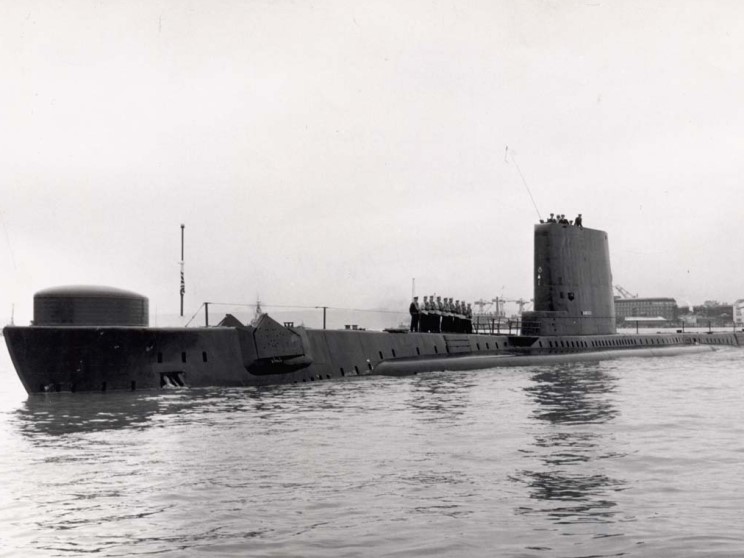
HMS Ambush P-418 seen in 1947.
HMS Ambush P-418 underway in 1947.
 
HMS Ambush S-68 seen in 1961 after modernization

Monday, December 13, 2010

Stranded sub’s sea trials breakdown

HMS Astute had to head back to its base in Faslane after what officials described as a 'minor defect'


A nuclear-powered submarine which ran aground two months ago broke down on its first day back at sea, it has emerged.

HMS Astute had to head back to its base in Faslane, Scotland, last week after what officials described as a “minor defect”.

Experts identified a fault in the steam plant, which affected the propulsion and desalination system that makes sea water drinkable, the Mail on Sunday said.

It is hoped the vessel will be back in service this week.

HMS Astute became stuck off the coast of Skye in October and ended up marooned for several hours – an error that eventually cost its captain, Cmdr Andy Coles, his command.

Cmdr Coles was replaced by Cmdr Iain Breckenridge.

Monday, May 24, 2010

Trident: Deadly – and very, very expensive

Trident nuclear submarine HMS Vengeance at Faslane. Photograph: Murdo Macleod

From the hill overlooking Gare Loch, the black-finned body of the nuclear submarine looks as benign as a whale, and almost insignificant against the hulking mountains beyond. But this small beast, tethered to a jetty at Faslane naval base, is a deadly one: it is one quarter of Trident, Britain's nuclear deterrent.

The four horsemen of Trident – Vanguard, Victorious, Vigilant and Vengeance – take it in turn to provide a continuous patrol of the world's oceans, wielding a cargo of up to 16 Trident ballistic missiles. Each missile is capable of travelling at least 4,000 miles; each carries three nuclear warheads, which can be released separately, to hit different targets, once the missile reaches space. And each missile represents the equivalent of many Hiroshimas.

Four hundred metres from the glittering loch, beyond a thicket of barbed wire, a knot of campaigners conduct a peace vigil, draping rainbow CND flags over Royal Navy signs and unveiling their latest work of art: "Cameron-Clegg. Trident value for money? How many deaths to the pound?" the poster, painted in black acrylic, reads. That morning, the hurriedly drafted coalition agreement between the Conservatives and the Liberal Democrats promised a commitment to maintaining Britain's nuclear deterrent while scrutinising Trident "to ensure value for money".

"I don't care if it costs a fiver. It's immoral," says protester Barbara Dowling. "How can you value a weapon when once it is used its purpose has failed?" adds Jane Tallents. She and her partner, Brian Larkin, painted the Clegg-Cameron banner. Tallents says she arrived here in 1984 and lived at the "peace camp", a colourful collection of caravans by the side of the base, for six years. Now the mother of two children, she has settled in nearby Helensburgh. "When I first got pregnant, I thought, 'Is it responsible to live next to a nuclear weapons base?' Then I thought there is nowhere in the world that is safe. The safest thing I could do for my children was to stay here and campaign to get rid of it." She pauses, dryly. "It's taken longer than I expected."

Sunday, May 23, 2010

Billions could be saved by scaling down Trident

Britain may be able to save about 11 billion pounds in defence costs if it were to end its policy of keeping at least one nuclear armed-submarine at sea at all times, a prominent defence think-tank said.


Defence spending is a prime candidate for cuts as Prime Minister David Cameron seeks ways to reduce a budget deficit set to reach 163 billion pounds this financial year.

Cameron's government outlined plans on Thursday to reduce the deficit, before an emergency budget due on June 22, including cutting defence ministry running costs by 25 percent.

Controversy has swirled around Britain's submarine-based nuclear weapons system, or Trident, with the Liberal Democrat party, the junior partner in the new coalition government, arguing that it should be replaced with a cheaper alternative.

The Conservative Party, the coalition's senior partner, wants to keep Trident.

Britain plans to replace Trident's four submarines when they become outdated, a plan the government estimated would cost between 15 billion and 20 billion pounds at 2006/2007 prices.

Ending Britain's so-called continuous-at-sea-deterrence (CASD) -- having a nuclear-armed submarine at sea at all times -- would remove the need to replace all four submarines, while prolonging the life of existing ones, the Royal United Services Institute think-tank said in its May journal.

SAVINGS

"Only building two or three could reduce the cost of the programme by up to 6 billion (pounds, on current estimates)," RUSI said. "Ending CASD now would further extend the service life of the existing submarines well beyond 2024, with significant savings, estimated at over 5 billion."

Cameron told reporters on Thursday such a move was out of the question.

"The short answer to that is no ... If it wasn't continuous at sea it wouldn't be a proper deterrent," he said.

RUSI argues that the nuclear threat against Britain is low, and that the likelihood of a nuclear attack by Russia, which it says is the only country able to deliver a nuclear first strike against Britain, was "near zero."

The think-tank also says reduced, but more varied, submarine patrols at times of tension would create uncertainty in the mind of the enemy, and that Britain's NATO allies were also a deterrent to attackers, reducing the need for CASD.

Wednesday, April 21, 2010

Defensive posture

The case for Trident is strong but it still needs to be made


The Trident nuclear deterrent is fast becoming a sort of holy grail in the national debate about how to reduce the deficit. Wilder and wilder figures for its lifetime cost are being bandied around, as those with a prior hostility to Trident leap on the poor state of the public finances as a pretext for scrapping it. Britain’s responsibility to be a force for stability in the world seems to be regarded, by some, as alarmingly dispensable.

At most, Trident represents 5 per cent of current defence spending, (including capital and running costs and the cost of the Atomic Weapons Establishment). Yet the more that money is tight, the more the justification for all expenditure, including Trident, must be sound. The question that needs to be asked is this: is a ballistic-missile submarine system the best and most appropriate use of this part of the defence budget?

Writing in The Times today, four respected retired generals sound a sceptical note. They argue that the programme to replace Trident should not automatically be protected but must be included in the Strategic Defence Review that all parties are committed to holding after the election. They make two main arguments. The first is financial. With the defence budget likely to be cut after the election, they argue that it is important to include a weapon that has a “significant” cost when everything else is up for grabs. They fear that money spent on new nuclear weapons will not be available to support troops, frontline equipment or crucial counter-terrorism work.

Their second reason is that changes in the international context, in particular the multilateral disarmament process being led by President Obama, are a reason to reconsider what relevance a nuclear arsenal has to modern warfare.

There are distinguished voices on both sides of this debate. It is a finely balanced one. Part of the problem is in anticipating what threats Britain might face in the future. Failed and rogue states abound in the world, and state failure is increasingly coupled with nuclear capability. That is why France still spends almost a quarter of its defence budget on nuclear weaponry, and has no intention of stopping. It is why the British Government’s decision to renew Trident was a realistic assessment of future threats.

Saturday, April 17, 2010

A Look at Britain's and France's Nuclear Arsenals

 The British nuclear submarine HMS Astute can carry up to 48 nuclear warheads.

For Great Britain and France, the possession of nuclear weapons is a question of national pride, but neither country wants to eliminate its deterrent in the future. For cost reasons alone, though, the countries' arsenals are expected to shrink in the coming years.

France and Great Britain are part of a small club of the five official nuclear powers. The French force de frappe, or deterrent, is made up of approximately 300 nuclear warheads, while the British Royal Navy has just over 160. Both have fleets of four nuclear-powered and nuclear-armed submarines, of which one is always at sea. Paris maintains four more squadrons of planes with nuclear weapons, three on the ground and one at the Charles de Gaulle aircraft carrier.

Since the end of the Cold War, both countries have considerably shrunken their arsenals. The production of weapons-grade plutonium has been stopped entirely. And Great Britain eliminated all the nuclear weaspons possessed by its army and air force.

Neither London nor Paris is playing a central role in the current debate over disarmament. France and Britain make the point that the United States and Russia must disarm themselves to the level of the two European countries before any need will arise for further negotiations.

Both Countries Look to Successor Generation, But Cuts Still Likely

Neither France nor Great Britain wants to fully give up their nuclear weapons, and both consider the round-the-clock nuclear deterrent to be indispensible. And both countries are working on the successor generation to weapons systems currently in their possession.

With fiscal budgets constrained, however, both countries are considering further limiting the scope of their nuclear arsenals. While speaking before the United Nations last September, British Prime Minister Gordon Brown said his country wanted to make due with three nuclear submarines in the future instead of four. The French government recently offered to create a joint sea-based nuclear deterrent by sharing submarine patrols. Experts see the proposal as a model for the future, but the idea has so far been rejected by London.

Cooperation in Europe is also complicated by the fact that the British nuclear program has long been deeply interwoven with that of the United States. The Trident II missiles that are deployed with British submarines are stored in a common pool of missiles of the same type at Kings Bay, Georgia.

Britain and France are the only countries in the European Union to possess their own nuclear weapons. As part of NATO, however, around 200 American short-range nuclear warheads are stored in Europe, including an estimated 20 weapons in Germany.

A look at the two European nuclear powers in facts:

France :

300 nuclear warheads

4 Le Triomphant class submarines, stationed at Ile Longue in Bretagne. Each submarine can carry up to 16 M45 missiles, which can in turn be armed with six war heads each.

The newest submarine, which goes into service in 2010, is armed with M51 long-range missiles with a range of 9,000 kilometers (5,592 miles).

3 squadrons of planes, each with 20 Mirage 2000N, stationed in Istres, Luxeil-Les-Bains and Saint Dizier. They are armed with air-to-surface missiles (ASMP) with a range of up to 300 kilometers.

20 Super Étendard fighter-bombers are stationed on the aircraft carrier Charles de Gaulle.

Great Britain :

160 nuclear warheads

4 Vanguard-class submarines, stationed at a base in Faslane, Scotland. Each can carry up to 16 Trident missiles (with a range of 10,000 kilometers) with a maximum of 48 war heads on board.

16 underground bunkers for storing nuclear weapons in Coulport near Faslane -- development and construction of the warheads through the Atomic Weapons Establishment (AWE) in Aldermaston, England.

spiegel 

South Atlantic Royal Navy nuclear powered sub en route to be decommissioned

According to the British press HMS Sceptre has been patrolling off the Falkland Islands because of renewed tension between the UK and Argentina.

HMS Sceptre was commissioned on February 1978 

This is HMS Sceptre final deployment as she is to be decommissioned at the end of this year. The Swiftsure-class submarine arrived on April 6 on a goodwill visit that the Royal Navy says reinforces the strong ties the Royal Navy already enjoys with the South African Navy.

The application to the South African National Nuclear Regulator (NNR) to approve the visit mentioned an 11-day visit, but the expected arrival date of mid-March was delayed. The NNR granted a Nuclear Vessel Licence to the SA Navy, which applied on behalf of the Royal Navy for the nuclear-powered submarines visit.

The SA Navy told the Digital Journal in an earlier interview that the Sceptre had been delayed by “operational requirements” but did not elaborate.

During the short stay, the crew took the opportunity to host a reception with the SA Navy and visited some of the SA Navy units. However, no joint exercises were conducted. Speaking to defence-Web aboard the submarine, the Commanding Officer, Commander Steve Waller, elaborated: “We were supposed to come here earlier, but due to operational reasons we were delayed. Because it’s the Easter stand down for the South African Navy and (they are) preparing for World Cup duties, we haven’t been able to organise an exercise. It’s just unfortunate timing at the end of the day.”

Monday, March 29, 2010

Babcock deal guarantees submarine work for 15 years

The owner of Devonport Dockyard in Plymouth has been guaranteed 15 years of work as a preferred engineering supplier for warships and submarines.

Some of Babcock's work will be carried out at Devonport Dockyard

Babcock International confirmed that it would be guaranteed the work between 2010 and 2025 after signing a terms of business agreement with the MoD.

The deal, worth about £1.2bn, is for the provision of submarine support, maintenance and decommissioning.

The work will be carried out at Devonport and on Clydeside, Scotland.

Defence Secretary Bob Ainsworth said the company would be Britain's lead partner for submarine work and the agreement would deliver savings and benefits to the MoD.

Friday, March 26, 2010

BAE wins UK naval contracts worth £427m

BAE Systems has won a £127million ($189million) four-year contract to produce the specification for development and manufacture of a new class of British warship, Defence Secretary Bob Ainsworth said.

Astute class submarine: Made in Cumbria

Ainsworth said he had also agreed for BAE to start building the fifth of a planned seven Astute class submarines in Barrow-in-Furness, and begin procurement for the sixth, at a cost of over £300million.

The warship contract was awarded after the government decided to proceed with the assessment phase for the Type 26 Combat ship, the Royal Navy's next generation surface warship, Ainsworth said in a statement.

Submarine Oceanographic System Development

Chelsea Technologies Group is to develop and supply the oceanographic sensor system for HMS Audacious, the fourth Royal Navy Astute class submarine. The oceanographic sensors are designed to provide improved situational awareness and enhanced knowledge of the ocean environment. The robust, high-precision sensors incorporate novel built in test technologies to extend calibration intervals and decrease maintenance costs.


The system combines the outboard oceanographic sensors with the expendable bathythermograph system and acoustic modelling tools to provide an integrated environmental suite. The system, together with a shore-based facility, will be delivered in 2010. Industry collaborators include Ultra Electronics and Lockheed Martin.

Chelsea's facility in the UK has previously delivered oceanographic systems for the first three Astute class submarines.

Friday, March 19, 2010

Two of the best - Dauntless and Astute on sea trials

Glasgow, United Kingdom | Two of the most advanced naval vessels in the world met for the first time this week, as Dauntless, the second of the Royal Navy’s Type 45 destroyers, and Astute, the first of class Astute nuclear powered attack submarine, combined on sea trials in the firth of Clyde.

Dauntless and Astute on sea trials in the firth of Clyde

 
Astute is the most advanced attack submarine ever supplied to the Royal Navy, incorporating the latest stealth technology combined with a world class sonar system, an improved capability for world-wide operations, much greater firepower, better communications and crew accommodation than in-service submarines.

Astute is designed to fulfil a range of key strategic and tactical roles including anti-ship and anti-submarine operations, surveillance and intelligence gathering and support for land forces. Displacing 7,400 tonnes and measuring 97 metres from bow to propulsor, Astute is significantly larger than the Swiftsure and Trafalgar class submarines that she will replace but requires fewer crew to operate her due to the advanced technology and automated systems on board.

The Type 45 anti-air warfare destroyers are the most advanced ships of their kind in the world today. With a primary role to defend a task force from any aerial attack, they are extremely flexible and can provide a wide range of capability ranging from humanitarian relief through to intense war fighting.

Thursday, March 18, 2010

Trafalgar Class Attack Submarines, United Kingdom

Six Trafalgar Class nuclear-powered attack submarines are in service with the Royal Navy. The submarines were built by Vickers Shipbuilding and Engineering Limited (VSEL), now known as BAE Systems Submarine Solutions. Trafalgar Class submarines are preceded by Swiftsure Class and succeeded by Astute Class submarines.

The first submarine in the class, HMS Trafalgar (S107), was commissioned in May 1983. The remaining submarines are HMS Turbulent (S87), commissioned in April 1984, HMS Tireless (S88), commissioned in October 1985, HMS Torbay (S90), commissioned in February 1987, HMS Trenchant (S91), commissioned in January 1989, HMS Talent (S92), commissioned in May 1990, and HMS Triumph (S93), commissioned in October 1991.

In December 2009, the Royal Navy decommissioned HMS Trafalgar, the first submarine of the Trafalgar Class. The HMS Turbulent is scheduled for decommissioning in 2011.

Trafalgar class submarine design

The design of the Trafalgar Class is identical to that of the Swiftsure Class submarine. The hull of the Trafalgar Class is covered with the anechoic tiles to absorb the sound waves of sonar. This feature makes the submarine more difficult to be detected by active sonar.

The Trafalgar Class is 2.5m longer than Swiftsure but has an almost identical internal layout. Equipped with strengthened fins and retractable hydroplanes to sail through thick ice, the Trafalgar Class design also incorporates a new nuclear reactor core and Type 2020 sonar.

Trafalgar Class command and control

The Trafalgar Class was earlier equipped with a submarine command system (SMCS), developed by BAE Systems Integrated System Technologies (Insyte). The SMCS was replaced with a new submarine command system next generation (SMCS NG) in December 2008.

The SMCS NG consists of an Ethernet local area network (LAN), multi-function consoles and two large liquid crystal displays.

The system handles large volumes of information and controls underwater weapons. The information received from the sensors is processed and displayed as real-time images on the command consoles.

Trafalgar Class submarine missiles

The Trafalgar Class submarine is armed with Raytheon Tomahawk Block IV land-attack cruise missiles (TLAM). A Tomahawk missile is fired from 533mm torpedo tubes.

The Tomahawk missile has a range of up to 1,600km and a maximum speed of 550mph. It is equipped with a two-way satellite data link that allows the reprogramming of the missile according to varied battle conditions. HMS Torbay was the first Royal Navy submarine to be fitted with the Tomahawk missile in April 2008.
Submarine torpedoes

The Trafalgar Class has homing torpedoes to attack submarines and surface vessels within a 15km range. It is equipped with five 533mm torpedo tubes that are capable of firing Spearfish torpedoes and missiles. These tubes can carry a total of 30 torpedoes and missiles. The Spearfish from BAE Systems is a wire-guided heavyweight torpedo with an active / passive terminal homing sonar. It has a range of 65km at a speed of 60kt.

Wednesday, March 17, 2010

Navy commander 'crashed £32m nuclear submarine after misreading depth reading on chart'


The HMS Superb crashed in the Red Sea after she was steered into underwater rocks - despite the massive stone pinnacle appearing on maritime charts


A Royal Navy commander crashed his nuclear-powered submarine into a shallow pinnacle he failed to spot on navigation charts, a court martial heard today.

Commanding officer Commander Steven Drysdale, officer of the watch Lieutenant Commander Andrew Cutler and navigation officer Lieutenant Lee Blair all admitted an offence of neglecting to perform their duty at a previous hearing.

The court martial at Portsmouth Naval Base was told that the charge relates to the grounding of HMS Superb as it travelled through the Red Sea on May 26 2008.

Captain Stuart Crozier, prosecuting, told the hearing that the submarine had been suffering from technical problems, causing it to lose speed.

He said there was pressure on Drysdale to ensure the submarine arrived in the Gulf on time for planned operations.

Captain Crozier said Drysdale ordered a new route to be plotted which cut about four miles off the previous route.

He also ordered the submarine to dive at a deeper depth where there was colder water, allowing the submarine to travel faster.
The new route was to be travelled at a depth of 250 metres rather than the planned depth of 100 metres.

But when the new route was charted by the plotting officer, who does not face the court martial, all three defendants failed to spot the pinnacle marked on the map as 132 metres deep.

The hearing was told that the pinnacle, which was the sole shallow point in the area, was highlighted on other charts but these were not used by the submarine crew because they had not been approved for navigation.

Captain Crozier said that when the submarine collided with the pinnacle, the vessel was brought to an almost immediate halt.

He said: 'The submarine collided with the underwater obstacle reducing its speed from 16 knots to three knots in a very short time.'

There was a significant amount of damage to the forehead of the submarine but no casualties.

Monday, March 15, 2010

UK Navy's nuke sub HMS Triumph ready for sea trials


HMS Triumph nuclear submarine of Royal Navy. A Royal Navy Photo


British Navy’s nuclear-powered submarine HMS Triumph is ready to set sail for sea trials after being refurbished for six years.

The vessel will undergo extensive sea trial for three months before being commissioned in the Royal Navy for a second time.

The submarine has been retrofitted at a cost of £300m ($455 million). Capability improvements include installation of latest sonar systems and an upgrade for the Tomahawk land attack cruise missile system.

The vessel has also been equipped with a new command and control system, a new internal fibre optic computer systems network and enhanced satellite communications system. Its safety features have also been enhanced further.

The seventh and last of the Trafalgar Class submarines of the Royal Navy, HMS Triumph was commissioned in October 1991.

UNIQUE Sight At Clyde Base

THE most dangerous submarine in the world has the world’s most sophisticated warship right in her sights – but luckily for all involved they are both on the same side.

Perhaps uniquely, the Type 45 destroyer HMS Dauntless and the new attack submarine HMS Astute found themselves tied up at berths six and seven at HM Naval Base Clyde last week.

Both are gearing up for their own separate sea trials in preparation for entry into full service with the Royal Navy and both overlapped in visits to the Faslane naval base by just hours.

Astute is the largest attack submarine ever ordered by the navy and she will spend her 25 year lifespan with Faslane as her home port. Her new Core H reactor never needs to be refuelled and her much increased firepower makes her one of the UK’s most potent means of maritime defence.

HMS Dauntless is the second of her class of Type 45, the largest and most powerful destroyers ever ordered by the Royal Navy and the largest ships ordered for UK defence (aircraft carriers excluded) since the Second World War.

Dauntless is the most advanced warship in the world – all electric powered, its sophisticated anti-aircraft systems can track and destroy a cricket ball travelling at three times the speed of sound.

Thursday, March 11, 2010

N-sub takes the plunge after refit

A NUCLEAR-powered submarine is back at sea following a major £300million refit at Devonport Dockyard.

HMS Triumph has sailed from her home port of Plymouth for trials to test improvements made during the six-year refit.

More than 1,000 specialists from Babcock, which operates the dockyard, and other contractors worked on the submarine totalling 2.75 million man-hours.

The refit work has seen her reactor refuelled and her weapons systems updated.

Captain Mike Robinson, the Superintendent Submarines for Devonport, said: "HMS Triumph sails for sea trials with significant safety and capability improvements, equipping her to provide a substantial contribution to defence during her second commission.

"The next few months will see HMS Triumph conduct extensive tests at sea ensuring that the modifications made to her propulsion and command systems withstand the demanding environment at sea both surfaced and dived.

"Following her planned acceptance back into the Royal Navy fleet later this year, her crew will then also be tested with the rigours of operational sea training."

The work – the last Trafalgar class submarine refit and refuel to be undertaken – was carried out in partnership with the Royal Navy's major contractor, and naval base neighbour, Babcock.

The company's Submarine Operations Director (Devonport), Gavin Leckie, said: "The quality of HMS Triumph as she leaves for sea trials, and timely completion of this extensive refit, is testament to the skill, dedication, and close teamwork by all involved, and the clear leadership from the Defence Equipment and Supplies agency project contract manager, Babcock project manager and the submarine's commanding officer."

Capability improvements on HMS Triumph have also included installation of the latest sonar systems, and an upgrade for Tomahawk land attack cruise missile systems.

Monday, March 8, 2010

HMS Triumph attack submarine sails marking end of an era

Nuclear powered attack submarine (SSN) HMS Triumph sailed from Devonport Royal Dockyard today (Thursday 4 March) following a successful Long Overhaul Period (Refuel) [LOP(R)] by Babcock – the last Trafalgar class submarine refit and refuel to be undertaken.


The extensive four year, 2.75 million manhour refit has included some significant capability improvements, as well as reactor refuelling, refurbishment work on all submarine systems, and addressing considerable emergent repair work.

Capability improvements have included installation of the latest sonar 2076 bow, flank and towed array systems, and upgrade for Tomahawk land attack cruise missile systems. A new command and control system has been installed, as well as a new internal fibre optic computer systems network and enhanced satellite communications system. An additional ballast pump has been installed to aid rapid deballasting, and a number of safety improvements incorporated to fire fighting and escape capabilities. Major equipments have been upgraded to support both efficiency and obsolescence management programmes, such as the chilled water plants.

The LOP(R), which saw some 30,000 work instructions raised and issued, and over 75,000 items of equipment overhauled, has included a number of challenges that were successfully met. Among these was the need for new inspection equipment to be designed, manufactured and commissioned to carry out surveys on the reactor systems. This required close working between Babcock, the MoD design authority and Rolls Royce to minimise programme impact. Additionally, repairs were successfully carried out by Babcock to both torpedo tube air ram cylinders which were far more extensive than anticipated before being surveyed at the start of the LOP(R). Further challenges included equipment obsolescence issues, often requiring fault diagnosis and resolution without original manufacturer’s drawings.

Commenting on the LOP(R), Babcock submarine operations director, Devonport, Gavin Leckie, said: “The quality of HMS Triumph as she leaves for sea trials, and timely completion of this extensive refit, is testament to the skill, dedication, and close teamwork by all involved. The significant safety and capability improvements undertaken during this substantial overhaul programme have fully equipped the submarine for her next commission.”

Wednesday, March 3, 2010

Captain defends BAE Systems Barrow sub Astute 'faults' claim

THE CAPTAIN of Barrow’s newest nuclear submarine has defended his boat against claims it had ‘serious faults’ during sea trials and had worried the crew.

The £1.2bn submarine Astute left Barrow for Faslane naval base near Glasgow, Scotland, last November for sea trials.

It returned back to its Scottish base after nearly two weeks of trials.

But an article in the Scottish Daily Record at the weekend reported the sea trials had been “plagued by serious faults.”

One navy insider told the Scottish paper: “There have been problems with Astute. Every time engineers think they have solved one problem, another crops up. This has to be sorted out quickly.”

The paper said another Navy source told it: “The crew are worried about the problems.

“They must be fixed without cutting corners.”

However, Astute’s captain, Commander Andy Coles, has hit back at the claims.