Japanese warplanes hit, from left, the USS West Virginia, USS Tennessee and USS Arizona at Pearl Harbor.
(Associated Press / December 7, 2009)
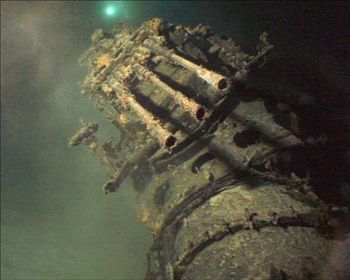
The remains of a Japanese mini-submarine that participated in the Dec.
7, 1941, attack on Pearl Harbor have been discovered, researchers are
to report today, offering strong evidence that the sub fired its
torpedoes at Battleship Row.
That could settle a long-standing argument among historians.
Five mini-subs were to participate in the strike, but four were
scuttled, destroyed or run aground without being a factor in the
attack. The fate of the fifth has remained a mystery. But a variety of
new evidence suggests that the fifth fired its two 800-pound torpedoes,
most likely at the battleships West Virginia and Oklahoma, capsizing
the latter. A day later, researchers think, the mini-sub's crew
scuttled it in nearby West Loch.
The loch was also the site of a 1944 disaster in which six tank landing
ships preparing for the secret invasion of Saipan were destroyed in an
ammunition explosion that killed 200 sailors and wounded hundreds more.
When the Navy scooped up the remains of the so-called LSTs and dumped
them outside the harbor to protect the secrecy of the invasion, it
apparently also dumped the mini-sub's remains, which were mingled with
the damaged U.S. ships.
"It's not often that a historian gets a chance to rewrite history,"
said marine historian and former Navy submariner Parks Stephenson, who
pieced together the evidence for the television program "Nova." "The
capsizing of the Oklahoma is the second most iconic event of the
attack. If one submarine could get in in 1941 and hit a battleship, who
knows what a midget sub could do today. Iran and North Korea are both
building them. It's very worrying."
Stephenson and his colleagues have put together a convincing chain of
circumstantial evidence, but it is just circumstantial, said Burl
Burlingame, a journalist at the Honolulu Star-Bulletin and author of
"Advance Force: Pearl Harbor."
"There is a good chance that this is the Pearl Harbor midget, but
I don't think the case is closed on it," Burlingame said. "At this
point, it is not hard evidence."
The two-man, 80-foot-long sub in question does not have a name of its
own. Each of the five subs in the attack was carried by a conventional
submarine and took its name from the mother boat. It is thus called the
I-16-tou --
tou being
Japanese for boat. Powered by a 600-horsepower electric motor, the sub
could reach underwater speeds of 19 knots, twice as fast as many of the
U.S. subs of the day.
The three pieces of the sub were found during routine test dives
between 1994 and 2001 by Terry Kerby, chief pilot of the Hawaii
Undersea Research Laboratory's submersibles Pisces IV and Pisces V. But
Kerby and others assumed they were a part of a war trophy that had been
captured by allied forces at Guadalcanal or elsewhere, towed back to
Hawaii and scuttled.
Stephenson got involved in 2007 because he was looking for the fifth Japanese mini-sub.
In 1941, a crewman on the I-16 had received a radio call from the
I-16-tou at 10:41 p.m. on Dec. 8 reporting the success of its mission.
That indicated to Stephenson that the mini-sub had found a calm place
in the harbor and hidden until the next night before surfacing and
sending the call.
The crew members would have then scuttled the craft because they could
not get it out of the harbor. The West Loch would have been a good
location to hide, but researchers could find no trace of the boat there.
A diver who had been looking for the mini-sub suggested that Stephenson talk to Kerby, who sent him pictures of his find.
"As soon as I saw the bow section with the distinctive net cutter, I
knew that we had found the fifth midget sub," Stephenson said. The
Japanese navy modified net cutters on the subs for specific missions,
and the one on the wreck was identical to those on the other mini-subs.
No torpedoes were found on the wreck, and evidence suggests that they
were not present when the boat was sunk. A newly declassified
photograph taken by a Japanese plane during the attack appeared to show
a mini-sub firing a torpedo into Battleship Row. A report to Congress
in 1942 by Adm. Chester W. Nimitz describes an unexploded 800-pound
torpedo recovered after the battle. That's twice the size carried by
the torpedo bombers.
That torpedo was apparently a dud that missed the West Virginia.
But an examination of the remains of the Oklahoma shows that it
apparently had underwater damage much larger than that associated with
aerial torpedoes. An underwater blast would have caused it to capsize,
Stephenson said. "Otherwise it would have settled to the bottom
upright," like the other sunken ships.
The 1944 disaster at West Loch occurred on May 21 as the Navy was
preparing to invade the Mariana Islands in Operation Forager. The Navy
clamped a top-secret classification on the incident to keep it from the
Japanese, and few records are now available. What is known is that it
was crucial to clear out the debris because the loch was by then the
site of an ammunition dump.
Records from the salvage ship Valve showed that it was brought into the
loch during the cleanup and its 250-ton crane was used for an
undisclosed reason. Stephenson thinks it lifted the I-16-tou, but there
are no records to confirm that.
The remains of the mini-sub were then dumped three miles south of Pearl
Harbor along with those of the LSTs, to be found by Kerby 50 years
later.
Bulkheads on the wreck are sealed, so researchers don't know whether
the mini-sub crew was trapped. But a map taken from one of the other
mini-subs showed the location of a safe house in Pearl City, Hawaii,
suggesting the crew might have scuttled the boat and escaped.
The "Nova" episode describing the search for the I-16-tou will air Jan. 5.
(Original News)




 Posts
Posts


