Your Ad Here
Showing posts with label US. Show all posts

Wednesday, December 22, 2010

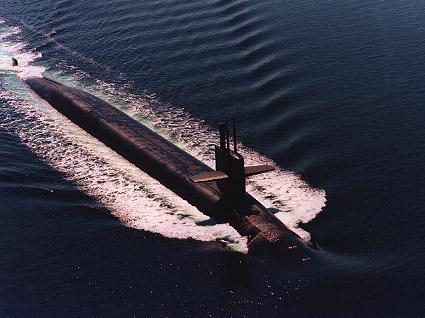
Pentagon Said Likely to Back New Design for Ballistic Missile Submarine

The U.S. Defense Department is likely to pursue a brand new design for its next nuclear-armed submarine, following a Navy recommendation during a key program review earlier this month, according to experts and observers.

The Pentagon's Defense Acquisition Board on December 9 completed an initial design review meeting on the so-called "SSBN(X)" effort, spokeswoman Cheryl Irwin confirmed last week. However, she indicated the department was not ready to release the review's results.

If approved by defense acquisitions czar Ashton Carter, the replacement submarine for today's Ohio-class ballistic missile vessels would enter its first major acquisition program phase, called "Milestone A."

A recent Congressional Research Service report estimated it would cost roughly $70 billion to replace the 12 ballistic missile submarines expected to populate the U.S. fleet by the end of this decade. The nation currently fields 14 Ohio-class boats.

The Navy has not released total cost projections for the new underwater craft, but has estimated it would spend $29.4 billion on the effort between fiscal 2011 and 2020. That figure, though, excludes costs for roughly two subsequent decades during which the 12 new submarines would be built and delivered.

The next-generation submarine is to initially carry today's Trident D-5 nuclear-armed ballistic missiles, but later could be fitted with new-design nuclear missiles and possibly conventional weaponry.

The first Ohio-class submarine to be replaced reaches the end of its 42-year service life in 2027. One subsequent vessel is slated to retire each year after that, with the last submarine expected to age out in 2040. The SSBN(X) submarines are to enter the fleet between 2029 and 2042.

One pivotal decision believed likely to come out of the Defense Acquisition Board review pertains to the approach the Navy will take in developing and building the replacement submarine. In an official "analysis of alternatives" that also has not been released, the Navy considered three possible design concepts for the Ohio-class follow-on, according to a recent Energy Department report.

Monday, December 13, 2010

Lockheed Martin to upgrade RMS minehunting underwater vehicle capability and reliability

Engineers at Lockheed Martin Corp. will upgrade the capability, reliability, and maintainability of the U.S. Navy's AN/WLD-1 Remote Minehunting System (RMS) -- a 23-foot-long semiautonomous, semisubmersible diesel-powered submarine that locates and classifies undersea anti-ship mines -- under terms of a $20 million contract awarded Friday from the Naval Sea Systems Command in Washington.

The RMS, an unmanned underwater vehicle (UUV) designed to help safeguard military and commercial shipping from hidden underwater mines, often requires frequent repair or replacement, Navy officials say. This can be a problem when operating from the Navy's Arleigh Burke-class destroyers, which can accommodate only one of the RMS vehicles.

Although the Navy is designing the Littoral Combat Ship to accommodate two RMS vehicles to provide sufficient redundancy for the maintenance-heavy minehunting UUV, the RMS also has been found to have a difficult time reliably detecting and classifying mines in shallow waters with rough sea floors, Navy officials say.
As a result, the Lockheed Martin Undersea Systems division in Riviera Beach, Fla. -- the RMS designer and manufacturer -- is taking on the RMS Reliability Growth Program to upgrade the minehunting system's reliability and capability. Lockheed Martin will do the work at its Riviera Beach, Fla., and Syracuse, N.Y., facilities.

Submarine defense systems that protect against torpedo attacks to be provided by Sedna Digital Solutions

Submarine electronics experts at Sedna Digital Solutions LLC in Manassas, Va., will provide the U.S. Navy with submarine defensive warfare systems that enable U.S. ballistic missile and fast attack submarines to respond automatically to torpedo attacks under terms of a $14.3 million contract announced last week by Naval Sea Systems Command in Washington.

Sedna Digital Solutions will provide the Navy with AN/WLY-1 acoustic interception and acoustic countermeasures systems for U.S. submarines. The AN/WLY-1 has threat platform sonar- and torpedo-recognition capability for early detection, classification, and tracking of torpedo threats to Navy submarines.

This submarine defensive warfare system , which allows radius of curvature and multipath ranging, also has a control subsystem for launch management of all onboard countermeasure devices and launchers.

Saturday, April 24, 2010

Goodrich lands Northrop Grumman deal

Goodrich Corp. has won a supply contract from Northrop Grumman Shipbuilding for parts on eight Virginia-class fast-attack nuclear submarines.

The agreement comprises the design and manufacture of sail cusps, which are composite structures attached to a submarine’s sail and hull. The product enables water to flow smoothly over the submarine’s surface, improving hydrodynamic performance.

Delivery is scheduled to start in the second quarter of next year.

Financial terms weren’t disclosed.

Northrop Grumman Shipbuilding, a unit of Los Angeles-based Northrop Grumman Corp. (NYSE:NOC), includes the former Northrop Grumman Ship Systems and Northrop Grumman Newport News shipbuilding segments.

Charlotte-based Goodrich (NYSE:GR) is a global supplier of systems and services to the aerospace and defense sectors.

Friday, April 23, 2010

Raytheon to develop SWIR sensor for next-generation photonics mast on Navy attack submarines

Electro-optical engineers at Raytheon Vision Systems in Goleta, Calif., are developing advanced short wave infrared (SWIR) hyperspectral imaging sensor technology for the next-generation photonics mast on U.S. Navy Virginia-class fast attack submarines under terms of a $7.4 million contract announced Tuesday.


Raytheon is doing the work as part of the Affordable Modular Panoramic Photonics Mast program. Navy researchers say they expect Raytheon to enhance the current state of art in SWIR imaging by proving higher resolution, area coverage, and sensitivity than is available today.

Awarding the contract are officials of the Office of Naval Research (ONR) in Arlington, Va.

The Affordable Modular Panoramic Photonics Mast program seeks to eliminate the need for mast rotational assemblies and related components, achieve 360-degree "quick look" search time that is five times faster than is available today, and develop SWIR detection and tracking capability under degraded and restricted conditions, Navy researchers say.

For the next-generation submarine photonics mast, Raytheon will develop a SWIR hyperspectral sensor in the 1-to-1.7-micron band that is able to track hostile targets with intermittent contact, as well as to track friendly targets marked with RF microchips or with chemical or physical markers.

Saturday, April 17, 2010

Melbourne defense firm reels in Navy submarine software deal

Melbourne-based Modus Operandi Inc. said Monday it has received a $600,000 deal to provide submarine intelligence analysis software for the U.S. Navy.

The small defense contractor has now won nearly a half dozen contracts since late 2009, cumulatively worth more than $3.3 million.

Its latest was a Small Business Innovation Research contract from the Naval Sea Systems Command at Washington Navy Yard. The deal is sponsored by the Program Executive Office for Submarines.

Terms of the project call for Modus Operandi to design software technology that will process and feed intelligence information from various sources into an integrated database for submarine commanders, the company said.

The new system "will provide submarine control room personnel, and ultimately commanders, with a vastly improved common operating picture allowing them to perform more mission types with greater confidence," Modus Operandi chief scientist Richard Hull said in a written statement.

Wednesday, April 7, 2010

Repair cost for sub Hartford nearly $87M

The Navy will pay another $36.6 million to repair the fast attack submarine Hartford after a collision March 20, 2009, with the amphibious transport dock New Orleans. This will bring the total repair cost to $86.9 million.

The Los Angeles-class attack submarine Hartford pulls into Mina Salman pier in Bahrain after colliding with the amphibious transport dock New Orleans in March 2009

General Dynamics Electric Boat was awarded the contract April 1. It will cover the final fabrication and installation of the hull patch, bridge access trunk, port retractable bow plane and the sail. The work, which will be performed primarily in Groton, Conn., is scheduled to wrap up by November.

Wednesday, March 31, 2010

Missing U.S. WW II sub found by film crew

A Toronto television production company says it has located the wreckage of a missing U.S. submarine that was sunk in 1944 in the South China Sea.

World War II submarine USS Flier (SS 25) in port in California in 1944. It was later sunk by a mine in the South China Sea and remained missing until a Toronto film crew located it in the spring of 2009. U.S. Navy photo handout by yap films.
In a news release, yap films said the U.S. Navy had confirmed the wreck they found was the World War II submarine USS Flier (SS 25) that sank and was lost since Aug. 13, 1944.

The Flier was a 1,525-ton Gato class submarine built at Groton, Conn., and went into service in October 1943. Of the 86 men aboard when the vessel hit a mine, 14 escaped, but only eight survived the swim to Palawan in the Philippines.

Monday, March 29, 2010

Navy commissions submarine New Mexico

Just before noon Saturday, Cindy Giambastiani took the podium on Pier 14 and issued the order: "Officers and crew of the USS New Mexico, man our ship and bring her to life!"


Giambastiani, sponsor of the $2.25 billion Newport News-built submarine, set in motion more than 100 submariners, who broke formation and rushed single file onto the topside hull of the Navy's newest warship, creating a blur of navy-and-white that cut through the center of a sea of onlookers.

Battling cool weather and a stiff easterly breeze, the Navy on Saturday morning commissioned the USS New Mexico, the sixth submarine of the Virginia class and the third delivered by Northrop Grumman Corp.

The setting for Saturday's ceremony invoked the lasting legacy of the company's Newport News shipyard, the nation's sole builder of nuclear-powered aircraft carriers and one of two to build fast-attack submarines.

Providing a frame behind the stage was the hulking Newport News-built George H.W. Bush carrier, the Navy's newest flattop that was tied to a pier a few hundred yards in the distance. Visible across Hampton Roads harbor was the yard's 23-story robin's egg-blue crane, standing over the sight where the next Navy carrier will rise.

The yard built its first submersible more than 100 years ago.

But it was 50 years ago that Newport News began its long partnership with the Navy in the submarine-building business when it launched the Robert E. Lee, the first of 14 Polaris-class subs.

Friday, March 26, 2010

Navy prepares to commission newest submarine, the New Mexico


The Navy is preparing to commission its newest submarine.

The Virginia-class attack sub New Mexico is outfitted with the newest technology.

NewsChannel 3 was given a special tour of the inside of the ship at Naval Station Norfolk.

The boat is one of the first *not* to have a standard periscope.

"We're the first class of submarine that has a non-penetrating scope," says Commander Mark Prokopius. "Basically all it is, is a color camera, black and white camera, and infrared camera all mounted on top of the mast that comes out of the water. So it's just like looking out of your digital camera but that's projected on a screen down in the control room."

The New Mexico will be commissioned this Saturday.

Tuesday, March 23, 2010

Raytheon Gets $28.1M Order for 8 Sub HDR SATCOM Antennas

Raytheon in Marlborough, MA received a $28.1 million firm-fixed-price modification to a previously awarded contract (N00039-08-C-0115) for 8 submarine high data-rate (Sub HDR) SATCOM antenna systems.

Sub HDR SATCOM Antenna

The Sub HDR (OE-562) antenna, which provides 2-way 256 Kbps data rates via satellite, is deployed by raising a mast-mounted antenna above the surface while the submarine remains submerged at periscope depth.

The OE-562 Sub HDR antenna, along with the OE-538 multi-function mast antenna, replaced the AN/BRA-34 submarine antenna…

The Sub HDR system connects to the Global Broadcast Service, the Milstar satellite constellation, and the Defense Satellite Communication System (DSCS) satellite constellation to send and receive information such as secure wide-band multimedia, voice and data traffic, imagery and video teleconferencing. The system receives on the Ka-band and has the capability to expand to the higher capacity Ku-band.

Raytheon’s Sub HDR multiband SATCOM antenna system (pdf) is designed for Virginia Class submarines, but can be used on other classes of US and UK submarines. The Virginia Class subs have 2 Sub HDR masts that allow simultaneous extremely high frequency (EHF) and super high frequency (SHF) communication.

Wednesday, March 17, 2010

New START Deal Near Completion

The United States and Russia could soon reach agreement on a successor to the 1991 Strategic Arms Reduction Treaty, which expired in December, U.S. Secretary of State Hillary Clinton said in an interview published yesterday.

A U.S. Trident D-5 submarine-launched ballistic missile takes off in a test. Washington and Moscow might be close to signing a new nuclear arms control agreement, U.S. Secretary of State Hillary Clinton said in remarks published yesterday (U.S. Navy photo).

 
"I'm optimistic that we'll be able to complete this agreement soon," Clinton told the Russian magazine The New Times, according to the Xinhua News Agency.

"It's a technically very complex treaty to accomplish. We share an interest in making real reductions in our strategic arsenals, and that is the most important point," she added (Xinhua News Agency I/People's Daily, March 15).

Clinton is expected to discuss the status of the pending agreement with top Russian officials during a two-day trip to Moscow starting Thursday, Agence France-Presse reported.

U.S. President Barack Obama and Russian President Dmitry Medvedev pledged last July to cut their nations' respective strategic arsenals to between 1,500 and 1,675 deployed nuclear warheads under the new treaty. Negotiators have reportedly also agreed to reduce each state's arsenal of nuclear delivery vehicles -- missiles, submarines and bombers -- to between 700 and 800, down from the 1,100-vehicle limit set by the leaders.

Thursday, March 11, 2010

Lockheed to provide design service for MK 41 missile launchers

Lockheed Martin has won a $17 million contract from the US Navy to provide engineering design services for the MK 41 Vertical Launching Systems integrated in the Navy’s Ticonderoga-class cruisers and Arleigh Burke-class guided missile destroyers.


The MK 41 Vertical Launching Systems. A Lockheed Martin Photo

As per the contract, Lockheed will work on missile integration, software development, integration of VLS into new ships, technical refresh, systems engineering and life cycle support for MK 41 VLS.

The cost-plus-fixed fee contract combines purchases for the US Navy and eight Allied navies under the Foreign Military Sales programme, Lockheed said.

The MK 41 Vertical Launching System is a ship-based missile launching platform. The fixed, vertical firing system can hold an array of missiles – anti-air, anti-submarine, land-attack and ballistic missile defense and other missiles.

The canister launching system consists of a single eight-cell missile module and can fire missiles against hostile aircraft, missiles and other land targets.

The MK 41 VLS is currently deployed at sea in 13 different configurations, ranging from a single module with eight cells to 16 modules with 122 cells.

Arms Control Advocates Call for Nuke-Free Arctic Zone

Amid growing military interest in the Arctic, a new report urges nations that border the North Pole region to declare it a nuclear weapon-free zone, the Canwest News Service reported today.

Polar bears examine the now-retired U.S. attack submarine USS Honolulu, shown about 280 miles from the North Pole in 2003. A recent report calls for the creation of a nuclear weapon-free zone in the Arctic region (U.S. Navy photo).

The report's authors, Michael Wallace and Steven Staples of the Canadian Pugwash Group, argue that in light of anticipated future competition over the Arctic's territory and resources, establishing the zone now would be a sensible precautionary measure that would also protect the area's environment from possible nuclear mishaps.

There are five nuclear weapon-free zone treaties covering Latin America and the Caribbean, the South Pacific, Southeast Asia, Central Asia and Africa.

The Antarctic is also considered a zone, as are the seabed, space and the moon, according to the James Martin Center for Nonproliferation Studies.

This month, foreign ministers' from the planet's Arctic nations -- Canada, Denmark, Iceland, Norway, Russia and the United States -- are set to meet in Canada.

Tuesday, March 9, 2010

Navy gets assistance with submarine satellite connectivity


The Navy has awarded Lockheed Martin Corp. a new $10.2 million task order through the Integrated Topside program to help develop advanced satellite communications systems for submarines.

The company will support the technology development phase of an initiative to develop a prototype of a satellite communications system suitable for integration into submarines, the Defense Department said March 5. The contract has options that could raise its value to $32 million.

The mission of the Integrated Topside program is to develop a scalable family of electronic warfare and radar and communications equipment to support multiple classes of ships and other Navy platforms.

Lockheed Martin will perform the work in Moorestown, N.J. The Office of Naval Research is the contracting activity.

Thursday, March 4, 2010

Critics worry over attack sub force plan


The fast attack submarine Virginia cruises through the Bay of Naples on Jan. 7 while on a scheduled deployment in the 6th Fleet area of responsibility, the Mediterranean Sea. Critics say the Navy's plan to reduce its submarine fleet by 20 percent will render it unable to meet important requirements.


The Navy’s plan to reduce its submarine fleet by 20 percent will render it unable to meet critical requirements, lawmakers and strategists say.

What’s still a mystery to many is whether the cuts are driven by decreasing missions or decreasing funding — or is this a gamble by the Navy that has a potential payout in the billions?

In the 2006 Quadrennial Defense Review, the Navy argued that a 48-attack-sub minimum is a moderate-risk force necessary to provide the roughly 10 subs that combatant commanders need on any given day.

But the 30-year shipbuilding plan released Feb. 1 would drop the current 53 attack subs to a low of 39 in 2030, then stabilize the fleet at 45 through 2040. The plan also eliminates the Navy’s four guided-missile subs in 2028 and replaces the 14 Ohio-class ballistic-missile submarines with 12 new boomers.

U.S. Navy Conceals Nuclear Weapons Production in California

A U.S. nuclear weapons assembly plant in California is off limits to any kind of photography, information gathering, or reporting. Local residents are unaware of the plant's existence and its potential radiological hazards. (Repost from Indymedia NL)

The United States Navy and Lockheed Martin have been concealing the assembly and movement of nuclear warheads in the densely populated San Francisco Bay Area for decades. The nuclear weapons facility is so secret that not only is photography strictly prohibited, but even making drawings or taking notes about the buildings from a public street is considered illegal. It is internally identified as a Naval Industrial Reserve Ordnance Plant (NIROP), one of several across the country.

Inside a single sprawling industrial building of approximately 100,000 square feet at the corner of 5th Avenue and Mathilda Avenue in Sunnyvale, California individual W88 nuclear warheads are assembled for the Trident II (D5) submarine-launched missile. Labeled externally by Lockheed Martin's designation simply as Building 181, the facility contains loading docks shielded from view from streets for trucks to load and unload their sensitive cargoes away from the eyes of the public or even from aircraft and reconnaissance satellites. Once loaded onto unmarked trucks, often under cover of darkness, the warheads may be moved to or from any of a number of nuclear weapons laboratories around the country or to the Kings Bay Naval Submarine Support Base in Georgia, just north of Jacksonville, Florida. That is where they are loaded onto Trident II missiles at the submarines' home base.

Wednesday, February 24, 2010

Pentagon to Allow Women on Subs

The Pentagon has decided it will lift its ban on women serving on U.S. Navy submarines, a long-standing rule.


Submarines are the only craft in the Navy on which women are restricted from serving, due to close quarters, which could make coed service difficult to manage, according to the Associated Press. The change comes during the ongoing challenge to repeal "don't ask, don't tell," the law barring gays and lesbians from serving openly in the military.

Defense secretary Robert Gates notified Congress of the proposed change in a letter. Congress members have 30 days to respond.

Secretary of the Navy Ray Mabus and the chief of Naval Operations, Adm. Gary Roughead, both support lifting the ban on women serving on subs, according to ABC News.

The Navy would begin by phasing in officers aboard the larger ships, which are easier to retrofit for coed quarters. Females would also not be allowed to serve alone; at least two women would be required to be on board. It would take about a year before the first women would board a sub, due to the amount of training need. ABC News says that the Navy hopes that 12-18 ROTC or Naval Academy graduates will enter submarine training.

U.S. Department of Defense Announces Latest Contract Awards

McKesson Corp., San Francisco, Calif., is being awarded a maximum $977,318,000 firm-fixed-price, prime vendor contract for replenishment pharmaceuticals and other authorized supplies. Other location of performance is Arizona. Using service is Department of Defense.  The original proposal was solicited on the Federal Business Opportunities wb site with two responses.  Contract funds will not expire at the end of the current fiscal year.  The date of performance completion is Feb. 28, 2011. The Defense Supply Center Philadelphia, Philadelphia, Pa., is the contracting activity (SPM200-03-D-1666).

                UNICOR, Washington, D.C., is being awarded a maximum $23,991,000 firm-fixed-price, sole-source, total set-aside, indefinite-quantity/indefinite-delivery contract for cold weather trousers. Other locations of performance are South Carolina, Kentucky and Florida. Using service is Army. There was originally one proposal solicited with one response. Contract funds will expire at the end of the current fiscal year. The date of performance completion is March 31, 2011. The Defense Supply Center Philadelphia, Philadelphia, Pa., is the contracting activity (SPM1C1-10-D-F012).

NAVY

                Northrop Grumman Shipbuilding, Inc., Newport News, Va., is being awarded a $19,400,942 modification to previously awarded contract (N00024-08-C-2100) for planned and growth supplemental work for the accomplishment of the fiscal year 2008 extended drydocking selected restricted availability (EDSRA) of USS Enterprise (CVN 65). EDSRAs are similar to overhauls in that they restore the ship, including all subsystems that affect combat capability and safety, to established performance standards. Additionally, an EDSRA provides an opportunity to perform hull inspections, recoating and other maintenance related evolutions below the waterline that cannot be accomplished while the ship is waterborne. The EDSRA provides sufficient time to perform more extensive repairs and testing than are possible during an extended selected restricted availability. Work will be performed in Newport News, Va., and is expected to be completed by March 2010. Contract funds in the amount of $19,400,942 will expire at the end of the current fiscal year. The Naval Sea Systems Command, Washington Navy Yard, D.C., is the contracting activity.